Jalen Hurts Is Expected to Miss the Rest of 2026, and His Health Is What Matters
The Eagles quarterback has blood clots in his legs and lungs, and Philadelphia’s season just got much harder.
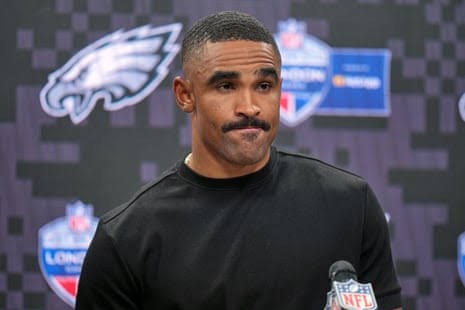
Philadelphia learned Monday that Jalen Hurts won’t be back anytime soon. The Eagles and Hurts’ agent, Nicole Lynn, said he has deep vein thrombosis and bilateral pulmonary emboli, meaning a blood clot traveled from his legs to his lungs. ESPN and league sources report he is expected to miss the rest of the season.
The most important part is this: the team said Hurts’ prognosis is “very good” and that it expects a full recovery. He’s described as clinically stable with no significant functional limitations.
By the numbers
2–4
Eagles’ record after Sunday’s loss
4
Straight losses, their first skid that long since 2020
57.8%
Hurts’ completion rate through five weeks, the lowest by an Eagles quarterback through Week 5 since 1994
18.4
Eagles’ points per game through five weeks, with 4.54 yards per play ranking 30th in the NFL
How it unfolded
It started as a calf injury. Hurts was cleated in the Rams game on Oct. 4 and asked for treatment on Oct. 8.
In London, an ultrasound showed a clot doctors called superficial, and they concluded it was safe for him to play. He played in the 19–17 loss to the Jaguars.
That changed after he got home. A follow-up ultrasound showed movement in the clot, which led the Eagles to rule him out of the Panthers game. The Eagles first said they didn’t plan to put Hurts on injured reserve, then reversed course after consulting a number of doctors and experts. He went on IR Saturday, and Tanner McKee started Sunday. Further testing Monday found the clots in his lungs.
What happened on Sunday
It didn’t go well. Bryce Young threw two touchdown passes, and the Panthers beat the injury-riddled Eagles 25–14. It’s Philadelphia’s first four-game skid since 2020, and the Eagles are 2–4.
McKee is a long way from a plug-and-play replacement. He was a sixth-round pick who has spent four seasons backing up Hurts, and he didn’t enter this season as the top backup. Andy Dalton beat him out in training camp, then threw a costly goal-line interception in the Week 3 loss at Chicago. Dalton was demoted and later released, which left McKee as the next man up. The Eagles have also added ex-Cowboys quarterback Joe Milton to the room.
On Sunday, McKee went 26-of-45 for 215 yards and a touchdown with no turnovers. But Philadelphia gained just 222 yards and punted on its first five possessions, and Saquon Barkley missed his second straight game with a hamstring injury.
The offense was already a problem before Hurts went down. Through five weeks, the Eagles were scoring 18.4 points per game and averaging 4.54 yards per play, which ranked 30th in the league.
The economics of it
The quarterback is the most expensive position and the hardest to replace. Every team pays a premium for a franchise passer, and every team knows what happens when he’s gone. The drop from Hurts to McKee isn’t a small step down. It’s a difference in how the whole offense can operate.
A backup quarterback is insurance. Teams pay a small amount to protect against a big, unlikely loss. The Eagles’ situation shows how thin that protection can be: their No. 2 wasn’t even the plan going into the season. Insurance only works if the person you’re insuring with can actually do the job.
The incentives push players to play through injuries. NFL careers are short, contracts depend on availability, and nobody wants to be the one who sat. That doesn’t mean anyone acted irresponsibly here, since the team’s doctors judged it safe to play at the time. But it’s a reminder that the system rewards toughness more than caution. I’m not a doctor, and I won’t pretend to second-guess the medical decisions.
My unfiltered take
Football is secondary here. Blood clots in the lungs are serious, and I’m glad the prognosis is good and the team is putting his recovery first. Nothing else about this matters if he isn’t healthy.
On the field, the season looks like it’s slipping away. At 2–4 with one of the league’s least efficient offenses and a backup who has barely played, I don’t see how Philadelphia climbs back into the race. It isn’t Hurts’ fault, and it isn’t fair to pin the whole season on one player. But this is what happens when your best player goes down and the rest of the roster isn’t strong enough to cover for him.
The best thing the Eagles can do is take the time. No rush, no pressure and no “we’ll see how he feels” talk. A full recovery matters a lot more than a few extra games in October.
Landrey
Never miss a take
Get my takes in your inbox
New articles and my unfiltered takes on baseball, football, golf and Formula 1, sent straight to your email.
No spam. Unsubscribe anytime. Privacy policy